
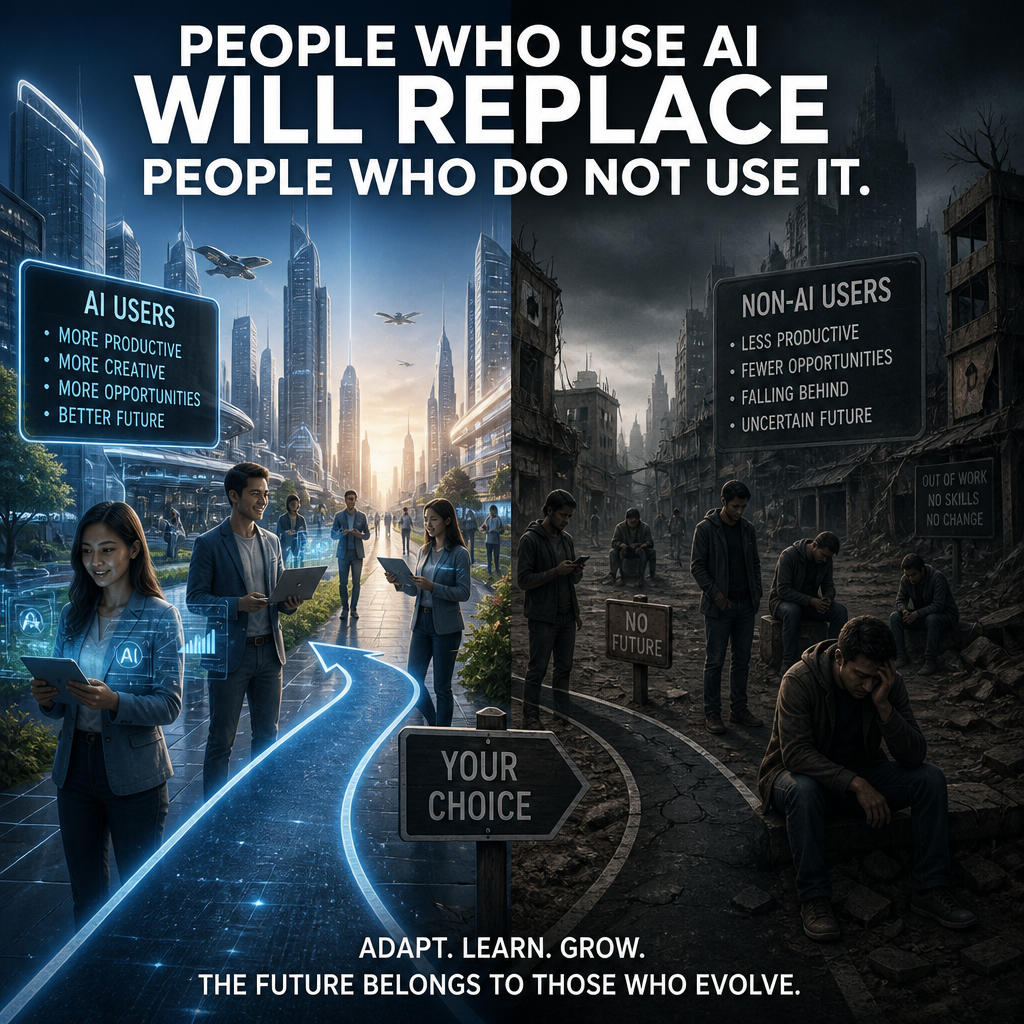
1. The Shift Is Already Happening: AI Changes Jobs Before It Replaces Them
Imagine two equally capable employees receiving the same busy Monday workload: emails to answer, meeting notes to organise, a report to prepare and customer issues to resolve. One completes every step manually. The other uses AI to draft replies, summarise notes, organise information and identify patterns in the report.
Neither person has become more intelligent overnight. But by the end of the day, the AI-assisted employee may have finished the routine work faster, checked it carefully and had more time for the difficult parts: making decisions, speaking with customers and improving the final result.
That is the shift already under way. AI is not a complete substitute for human judgement, relationships, accountability or creativity. It cannot truly understand a customer’s frustration, take responsibility for a high-stakes decision or decide what is right for a business in a specific context. People still do those things.
The competitive risk is different: colleagues and competitors can combine human strengths with AI speed.
Consider a customer service team. AI can summarise a long case history and draft a reply based on company guidance. The agent still reviews the details, adjusts the tone and solves the customer’s actual problem. Instead of spending most of their time searching through messages and writing routine responses, they can focus on complex cases where empathy and judgement matter.
This is The AI Advantage: producing higher-quality work faster, making better-informed decisions and directing attention toward the work that matters most.
2. Why People Still Matter: The Human Skills AI Cannot Own
AI can generate options quickly. It can suggest a reply, summarise a report, draft a plan or identify patterns in information. But it cannot truly decide what is appropriate, accurate, ethical or useful in a particular human situation. That still requires people.
Consider a nurse using AI to summarise a patient’s history. The summary may save valuable time, but the nurse notices anxiety in the patient’s voice, explains unfamiliar terms with care and recognises when something does not seem right. The nurse is accountable for the decision and for the patient’s experience. AI can process information at scale, but it cannot build trust at the bedside.
The same applies to teachers and managers. AI may suggest lesson ideas, prepare notes or organise feedback, yet a teacher reads the mood of a classroom and adapts in the moment. A manager can use AI help to prepare for a difficult conversation, but must still listen, negotiate, lead and take responsibility for the outcome.
These are not minor additions to work. Empathy, contextual judgement, leadership, negotiation and understanding what customers actually need are often what make work valuable. AI can offer possibilities. People provide purpose, set priorities and decide which option serves the situation best.
3. Real-World Examples of People Becoming More Valuable With AI
Consider a marketer preparing a campaign. AI can produce initial campaign concepts, versions tailored to different audiences and a week’s worth of social posts in minutes. But it cannot fully understand the brand’s hard-won reputation, the nuances of its customers or the message most likely to build trust. The marketer uses those drafts as raw material, selects the strongest direction and adds the insight that makes the campaign effective.
For a small business owner, AI help can turn a messy meeting transcript into an action list, draft a courteous follow-up email and compare supplier proposals against stated criteria. These are useful time-savers, not replacements for ownership. The owner can spend the recovered time talking to prospective customers, resolving concerns and strengthening relationships that drive the business forward.
The same applies to a financial analyst or project manager. AI can summarise a lengthy report, highlight apparent data patterns and create a presentation outline. The professional must still check the source material, test assumptions, spot what the tool has missed and make recommendations that account for commercial risk and organisational priorities.
In each case, the AI user is not necessarily working harder. They are completing the routine portion of work in minutes, then reinvesting that time in judgement, strategy and human connection. That is where their value grows.
4. The Productivity Gap: How AI Admin and AI Automation Create Time
A large share of modern work is not the work people were hired to do. It is inbox management, meeting summaries, document formatting, spreadsheet updates, scheduling and repetitive status reports. Each task may take only a few minutes, but together they consume hours that could be spent on customers, problem-solving or professional development.
AI Admin is the practical use of AI to reduce this daily administrative load. It can draft an agenda from a project brief, extract actions and owners from meeting notes, turn a rough list into a usable checklist or rewrite an unclear email in a professional tone. The employee remains responsible for checking the result, but no longer has to start every routine task from a blank page.
AI Automation goes a step further by connecting repeatable steps. For example, a business might automatically sort incoming enquiries by topic, generate a standard first response or produce a weekly report from data already held in its systems. This reduces manual handoffs and makes routine processes more consistent.
The numbers add up quickly. Saving just 30 minutes a day equals 2.5 hours a week, or more than 10 working days across a year. That is not simply reclaimed time. It is capacity that can be reinvested in better customer service, learning, careful decision-making and higher-quality work.
5. Simple Ways to Start Using AI Without Becoming an Expert
You do not need to automate an entire role, learn technical jargon or overhaul your working day to gain The AI Advantage. Start with one frustrating task that occurs often and takes more time than judgement. Summarising a long document, drafting a routine email, turning meeting notes into actions or creating a first version of a plan are all useful starting points for AI help.
Clear instructions produce more useful results. A simple prompt structure is:
- State the role
- Provide the relevant context
- Describe the task
- Specify the format you want
For example: “Act as a project coordinator. Turn these notes into a five-point action list with owners and deadlines.”
Use AI for repetetive tasks responsibly. Give it accurate inputs, check every important output and remove confidential, personal or commercially sensitive information unless your organisation has approved the tool and process. AI can make errors, miss context or present an uncertain claim confidently. Treat its output as a draft to review, not an answer to accept automatically.
It also helps to list the tasks that regularly consume time but do not require deep judgement. Look for repeated emails, document formatting, updates, summaries and checklists. These are often the quickest opportunities for AI Admin.
The objective is not to hand over your thinking. It is to reduce busywork, leaving more attention for decisions, relationships and original problem-solving.
6. The Real Choice: Compete With AI or Learn to Work Alongside It
Most jobs will change long before they disappear. AI is already reshaping everyday work by helping with drafting, organising, summarising and routine administration. The people most likely to benefit are those who learn to give clear instructions, review outputs carefully and improve the final result with their own knowledge and judgement.
This is not about AI making capable people less necessary. In many roles, it makes their expertise more valuable. AI can create a first draft, spot patterns or suggest options, but it cannot fully manage a client relationship, navigate a sensitive conversation, take responsibility for a decision or understand what matters most in a specific situation. Critical thinking and effective communication still matter. The real advantage comes from combining those human strengths with faster execution.
Start small. Choose one repeatable task this week, such as turning meeting notes into action points, drafting a standard email or summarising a report. Test an AI productivity workflow, compare the time it takes with your usual approach, then refine your prompts and review process over several attempts. A small time saving on a task you do regularly can add up to hours reclaimed over a year.
The choice is not between people and AI. It is between resisting tools that are changing how work gets done and learning to use them responsibly. AI will not replace people who bring judgement, expertise and human value, but people who use AI well may gain an advantage over those who insist on doing every task the old way.