
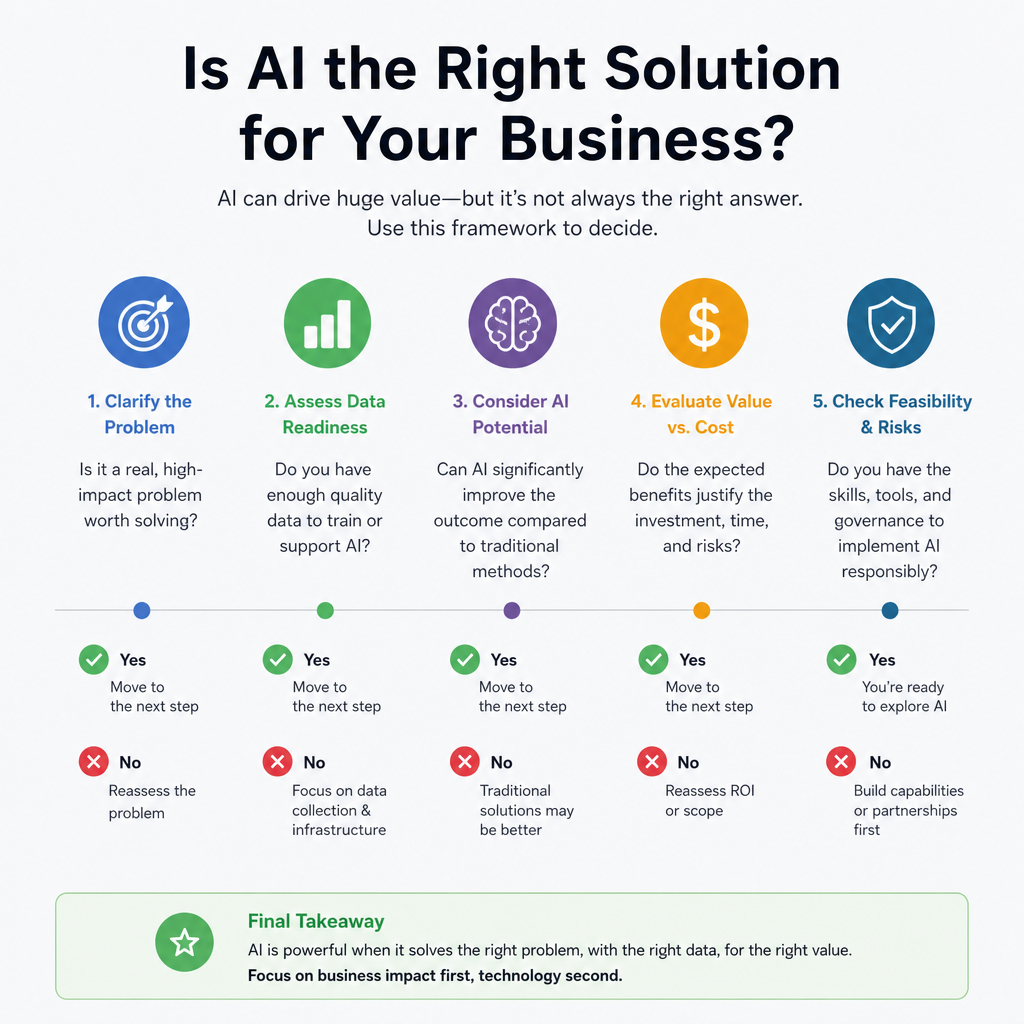
Start With the Business Problem, Not the AI Tool
Every small business owner is hearing the same message: adopt AI or risk falling behind. New tools promise faster marketing, smarter customer service and effortless administration. Yet buying an AI subscription because it is popular is rarely a sound business decision. Technology creates value only when it solves a real, specific problem in your business.
The better starting point is not, “Which AI tool should I use?” It is, “Where is my business losing time, money or customer opportunities?” Clear goals keep AI adoption focused. You may want to reduce the hours spent on administration, shorten customer response times, improve follow-up after enquiries or increase sales conversions from your website and email campaigns.
Use a simple three-part test before considering any tool:
- Identify the repetitive task: What happens often enough to create a burden? This could be answering the same customer questions, writing routine emails or entering information into multiple systems.
- Calculate its current cost: Estimate the staff time involved, the direct cost per transaction, and the cost of mistakes or slow responses.
- Define a worthwhile outcome: Decide what improvement would justify automation. For example, saving five hours a week, replying to enquiries within minutes, or reducing missed leads by 20 percent.
This approach turns AI from a vague trend into a practical business decision. If a tool cannot improve a defined workflow in a measurable way, it is probably not the right investment yet.
Identify Workflows That Are Ready for AI
The best AI opportunities are rarely found in one-off, highly creative or sensitive tasks. They tend to sit within high-volume workflows that repeat often and follow reasonably predictable patterns. If your team handles the same type of request dozens of times a week, AI may be able to reduce the effort involved while maintaining a consistent customer experience.
Review the everyday processes that consume staff time. Useful candidates may include:
- Booking appointments and sending confirmations
- Responding to routine customer questions
- Drafting social posts, newsletters or marketing copy
- Extracting data from invoices and routing them for approval
- Summarising meeting notes and assigning follow-up actions
For example, a local cleaning or home repair business could use an AI chatbot on its website to answer common booking questions, such as service areas, availability, prices and preparation requirements. The chatbot can gather basic details and direct straightforward enquiries into the booking workflow. Staff can then spend more time helping customers with unusual requests, complaints or jobs that require a detailed quote.
Not every workflow should be handed to AI. Tasks involving sensitive judgement, complex negotiation, confidential information or final professional accountability still need experienced human involvement. AI can support those decisions by preparing information or drafting a response, but it should not become the final decision-maker.
Assess the Potential Gains in Efficiency
Before paying for another AI subscription, estimate whether it can create a worthwhile improvement in efficiency. The goal is not to use AI because it is available. It is to see whether it saves enough time, reduces enough friction or improves enough customer outcomes to justify its cost.
Start by measuring the current baseline for one workflow. Track the hours your team spends on the task each week, the average response time, error or rework rates, and the cost per transaction or completed job. These figures give you something concrete to compare once a new tool is in place.
For example, a small e-commerce shop may spend several hours each week writing product descriptions and promotional emails. AI could produce first drafts from product details, key features and brand guidelines. A team member can then check the wording, correct inaccuracies and add the final brand voice before publishing. The business may not eliminate the marketing role, but it can publish campaigns faster and allow staff to focus on strategy, product selection and customer questions.
Be realistic about the likely gain. AI often delivers its strongest value by helping capable people work more quickly and consistently, rather than replacing employees. If a tool saves two hours a week but requires constant corrections, complicated setup or additional oversight, its true value may be limited. Compare the time saved and quality gained against the monthly cost, then decide whether the workflow is genuinely improved.
Choose Between Automation, AI and Human Expertise
Not every process needs AI. Standard automation follows clear, predefined rules: if a customer has not paid by a certain date, send a reminder; when a website form is completed, add the contact to the CRM; when an appointment is booked, send a confirmation. For stable, repeatable tasks with few exceptions, this type of workflow is often cheaper, more reliable and easier to manage than AI.
AI is more useful where the task involves language, variation or pattern recognition. It can interpret a customer’s question, generate a first draft of content or identify themes across feedback. That flexibility is valuable, but it also means outputs can be inconsistent and require more oversight.
Consider a plumbing business. Automated text or email reminders can reduce missed appointments because the process is simple and rule-based. After a job is completed, AI could help draft a tailored follow-up message asking for a review, offering maintenance advice or suggesting a related service. A staff member can then check the message before it is sent.
The strongest approach is often a combination of automation, AI and human expertise. Use automation for predictable steps, AI to accelerate work that involves communication or analysis, and people for judgement. Keep human review in place for customer-facing messages, financial decisions, legal matters and anything that affects your brand reputation.
Check the Risks, Costs and Readiness of Your Business
Before introducing AI into a workflow, check whether your business can support it properly. The subscription price is only one cost. Factor in setup time, integration work, staff training, quality checks and the ongoing attention needed to keep the tool useful.
Start with compatibility. An AI tool that does not connect reliably with your CRM, accounting software, email platform or booking system may create more manual work instead of improving efficiency. Ask what data can move between systems, whether integrations are included in the price and who will be responsible for fixing problems when they arise.
Data privacy also needs careful attention. Avoid entering customer records, financial details, health information or confidential business material into public AI tools unless you understand exactly how that information is stored, processed and potentially used. Review the provider’s privacy terms, user permissions and data retention policies. Where possible, use business-grade accounts with clear controls.
Accuracy is another ongoing requirement. AI can produce convincing but incorrect information, so someone must own the review process, particularly for customer communications or documents that affect money, compliance or reputation.
A low-risk pilot is the sensible starting point. Test one tool on a limited task for a set period, such as four weeks. Define success measures in advance, including time saved, error rates, response times and staff adoption. Gather feedback from employees and customers, then decide whether to expand, adjust or stop.
Make a Small, Measurable Decision
AI is right for your small business when it improves a clearly defined workflow, produces measurable efficiency and fits your budget, systems and tolerance for risk. It does not need to transform the entire business on day one. A useful result might simply be faster customer replies, fewer hours spent drafting routine communications or more consistent follow-up after a sale.
Keep the decision practical:
- Choose one specific problem with a clear owner and a measurable cost.
- Test one AI or automation tool, rather than buying several platforms at once.
- Set a fixed trial period, such as 30 days.
- Record baseline results, then measure time saved, quality, errors, response times and costs during the test.
- Keep human review where customer trust, financial decisions, legal obligations or brand tone are involved.
- At the end of the trial, decide to scale the tool, refine the workflow or stop using it.
Treat AI as a business capability, not a trend to chase. The strongest approach combines automation for routine work, AI for tasks involving language or patterns, and human expertise for judgement and accountability.
The best AI investment is not the most advanced tool. It is the one that helps your business serve customers better and operate more effectively.